Written by Claire Binkowski
This story originally appeared in the February 2026 issue of Premier.
Often the first in the barn and the last to leave, assistant trainers are the steady heartbeat of the horse industry. They carry the weight of long hours, quiet sacrifices, and an unwavering commitment to the horses and programs they help shape. More than a supporting role, they are the future, carrying on tradition while redefining what excellence looks like for the next generation. This series focuses on the assistant trainers who keep the industry moving forward. Because while the spotlight may not always find them, their dedication doesn’t just support the sport—it shapes what it becomes.
Careers in the horse industry are often shaped by defining moments, and for Thomas Lamson, that moment came early. Long before he understood what it meant to be a professional horseman, a childhood connection with an unforgettable horse planted a seed that would grow into a lifelong calling.
Thomas grew up in Randolph, Vermont, a small rural town he describes as “a great place to be in the summer and beautiful in the fall,” though he’s quick to add that in winter “it’s not nearly as nice unless you really like the cold and snow.” It was there, at just four years old, that a chance encounter set the course for his life. His father was working on a dairy farm that happened to have a horse named Atticus, and from the moment Thomas met him, he was smitten.
“Atticus opened up a crucial door for me,” he says. “It was when I first realized I always wanted horses to be part of my life.”
Although his mother had grown up riding, no one in Thomas’ family was actively involved in the equine industry. Looking back, he recognizes just how pivotal that early experience was. “If I had not had the opportunity to ride Atticus, who knows where I would be now,” he reflects. That sense of gratitude has stayed with him. “I’ve tried to carry that sentiment with me—to be thankful for the opportunities I’ve had and confident that things often work out the way they’re supposed to.”

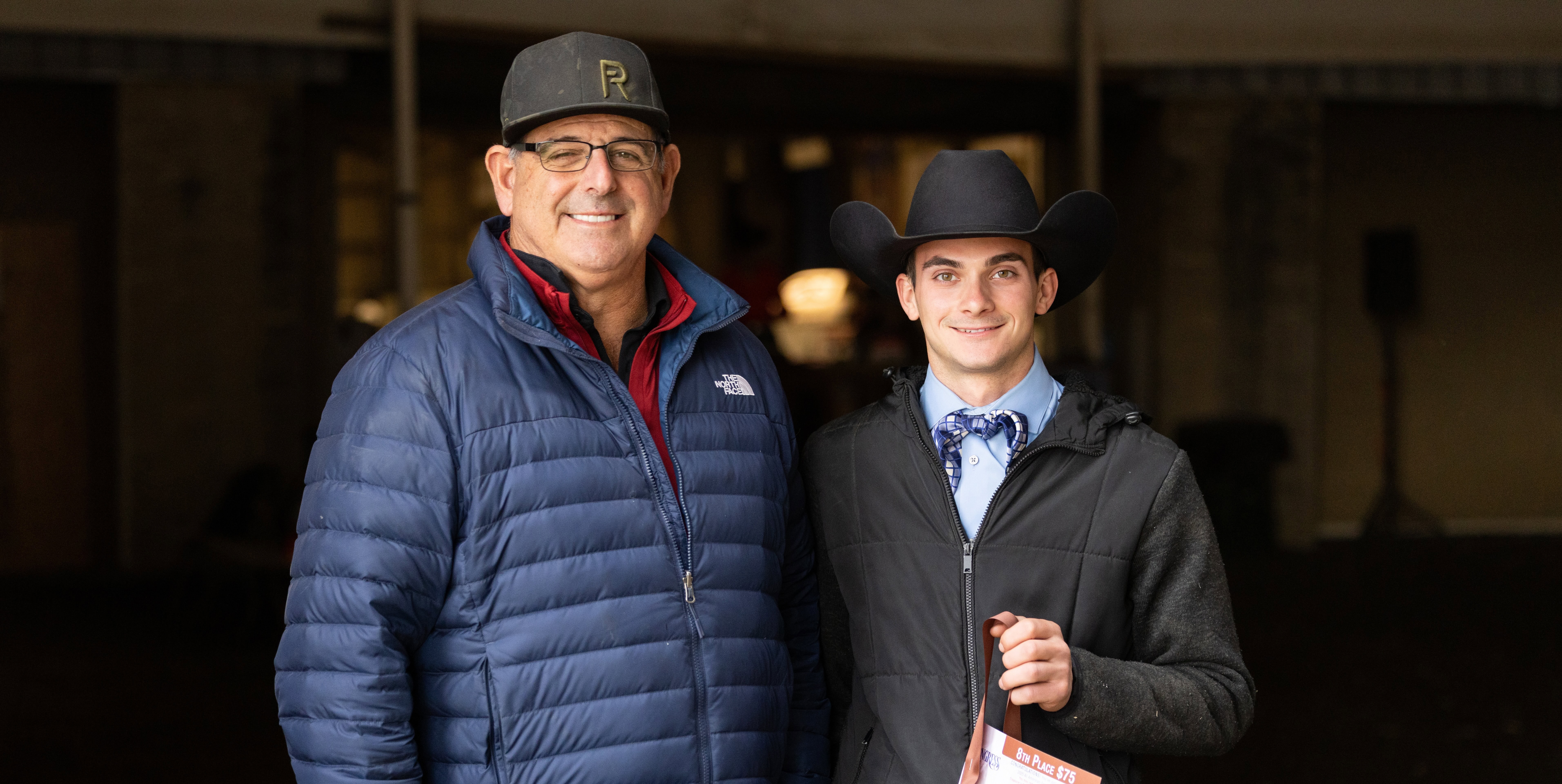
Photo © Shane Rux Photography
As the years passed, Thomas’ bond with horses deepened. What began as a hobby soon evolved into competing at local shows, then expanded to regional and national events. “As I became more interested in the performance horse world, I knew I wanted to have a job in the equine industry,” he says. “Being able to turn my love of horses into a career has been nothing short of a blessing.”
With his sights firmly set on becoming a horse trainer, Thomas quickly learned that passion alone wouldn’t be enough. He came to understand that talent and ambition could only take him so far—strong mentors would be essential to his growth and long-term success. “Knowing what I know now, I’ve grown to deeply appreciate the wisdom and experience my mentors have shared with me,” he says. “Having mentors in this industry is crucial, and it’s something that I didn’t fully grasp the importance of when I first started.”

Photo © Premier Sires
Among all his mentors, one stands out above the rest. “Without question, Gretchen Mathes,” Thomas says. “She truly cares about the animal and is a great horsewoman.” He credits her honesty and high standards for shaping the horseman he is today. “She’s tough on me because she cares, and she continues to push me to be better and learn more.”
Today, Thomas works for Gene Spagnola (“Geno”) of Powder Brook Farm in Harwinton, Connecticut, where he has been for six years. The opportunity came unexpectedly. While competing at a show in New Jersey during his final youth year, Geno approached him with a job offer. “Having someone of his level and skill seek me out and see potential in me was not only a surprise, but an honor,” Thomas says. “Becoming a horse trainer up until that point was a dream, but Geno helped turn that dream into a reality.”
Prior to joining Powder Brook Farm, Thomas assisted Erin Cecchini of Five Star Performance Horses, where the opportunity to work with hunter and over fence horses expanded his skill set and helped him become a more well-rounded horseman. Just as important, those years instilled lessons that would stay with him throughout his career.
If horses have taught Thomas anything, it’s patience. “No two horses are the same,” he explains. “You need to learn to listen to them. Good things take time. Rome wasn’t built in a day.” That mindset is reflected in the horses that have shaped the most important chapters of his young career.
Among those that left an indelible mark are Algorithm, who carried Thomas to Top 15 finish in the Hunter Under Saddle at the Congress, and Best Lopin Machine, the mare who helped him win his first professional trophy and his first AQHA World Championship Show hardware. Perhaps most meaningful, however, was Becuz I Can—the first horse Thomas started entirely on his own and who went on to place Top 10 at the Congress. “You have a special sort of bond with the first horse you start,” he says. “To be able to achieve such an accomplishment was the cherry on top. I was so proud.”
Those moments of success, however, represent only one side of the journey. Behind every milestone is the daily grind of a demanding profession. Being a horse trainer is far from easy, and Thomas is quick to acknowledge the challenge of balancing multiple horses, clients, and responsibilities. Still, the rewards far outweigh the difficulty. For him, the best part of the job is working alongside Geno, whom he considers a model professional horseman. “With Geno, success is never individual,” Thomas says. “It’s something he shares, and he’s constantly uplifting the team around him.”
That team-first mindset extends to Thomas’ own accomplishments. His resume includes earning the title of Bronze World Champion in the Level 2 Senior Trail at the AQHA World Championship Show, along with Top 10 finishes at both the All American Quarter Horse Congress and the NSBA World Championship Show. Earlier on, he also found success in the youth ranks, including a fourth-place finish in the Showmanship at the Congress. Still, he is quick to share the credit. “It takes a village,” he says, echoing the example set by his boss. “No man can do it alone.”
